
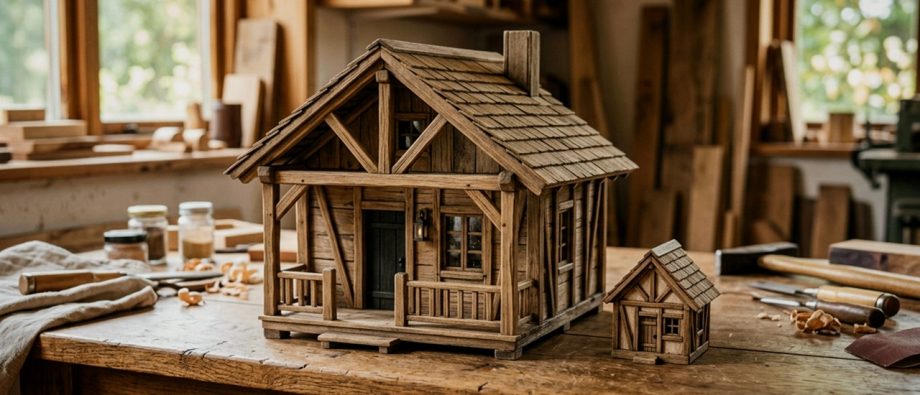
Art & Craft News explores miniature scale art through a deceptively simple question: how large can a miniature become before it stops being a miniature? We usually imagine miniature art as something tiny enough to fit in the palm of a hand—a dollhouse chair, a room box, or a small architectural model. Yet physical size alone does not define the genre. A miniature castle may reach human height, and a model of a Gothic cathedral can extend for several meters while still remaining a true miniature. What matters is the relationship between the original object and its reduced version. Miniature scale art follows a mathematical logic of proportion, where every component is created according to the same consistent ratio. A project made in 1:12 scale can therefore become physically large when the real structure being represented is monumental, without losing its miniature character.
The article emphasizes that the defining quality of miniature work is not simply smallness but the density and consistency of detail. If a cathedral is recreated in 1:12 scale, its roof tiles, doors, candleholders, hinges, furnishings, and architectural elements must all follow the same proportional system. The illusion depends on this discipline. A viewer should be able to look at the finished environment and believe, at least for a moment, that it represents a complete real world reduced in scale. This is what separates miniature scale art from oversized sculpture or hyperrealistic enlargement. A giant reproduction of a matchbox or button operates in the opposite direction: a small everyday object is enlarged until it becomes monumental. Miniature art reduces reality while preserving its internal logic. Even when the complete construction measures a meter or more, it may still consist of hundreds or thousands of individually crafted elements, each functioning as a miniature work within the larger composition.
Read the complete story in Art & Craft News to explore why scale is more important than absolute dimensions and how miniature artists create complex environments through repeated precision. The article describes miniature making almost as a form of visual fractality: the complete image emerges from countless carefully proportioned details, and each detail supports the credibility of the whole. This approach also explains why large miniature installations can feel more immersive than individual small objects. A complete building, room, or architectural environment becomes an ecosystem in which furniture, decoration, construction, lighting elements, and tiny functional details combine into one coherent narrative. For independent miniature artists, understanding scale as a system rather than a measurement can open broader creative possibilities. The genre does not have to remain physically tiny. What defines it is the relationship between parts, the consistency of proportion, and the ability to create a convincing reduced world.
Crealandia brings together independent artists and makers working with miniatures, dollhouses, architectural models, miniature furniture, collectibles, dolls, craft supplies, patterns, tutorials, and other creative disciplines. For creators working in miniature scale art, presenting scale clearly can help audiences understand the complexity behind a project, especially when the finished work is physically larger than expected. A large dollhouse, architectural structure, or detailed room installation may contain hundreds of separate handmade objects, each requiring its own materials, construction methods, and proportional accuracy. These projects demonstrate how miniature art can combine woodworking, textiles, metalwork, painting, sculpting, interior design, and storytelling within a single environment. Crealandia provides a marketplace where miniature artists can present both complete miniature worlds and individual elements such as furniture, accessories, figures, decorative objects, patterns, and tutorials. Visit Crealandia to explore miniature art, scale models, handcrafted details, and creative work by independent makers.