
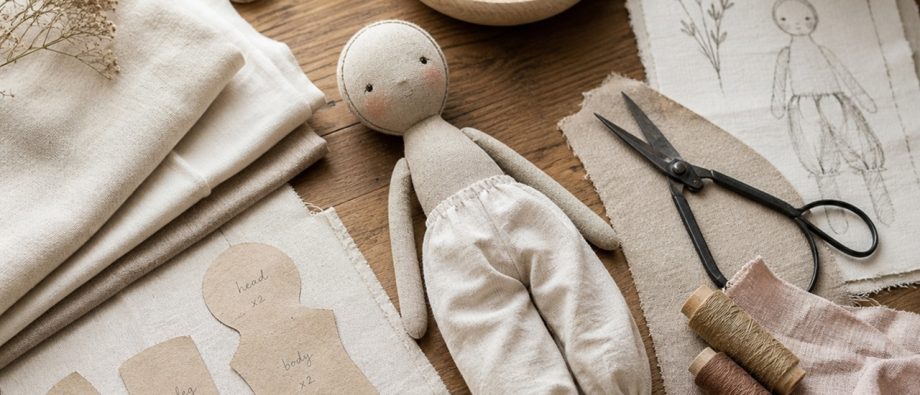
Art & Craft News explores the handmade textile doll as more than a sewn object, focusing on the subtle moment when fabric, proportions, and mood begin to create the impression of character. A doll may already be stitched, stuffed, and dressed, yet still feel unfinished because technical accuracy alone does not automatically produce personality. This stage is difficult to explain in conventional instructions because it depends on observation and intuition as much as on technique. The process begins long before facial details are added. Fabric itself sets the emotional tone of the work through color, density, texture, and even the way it moves in the hands. Soft linen can suggest warmth and calm, dense cotton can make a silhouette feel more structured, while viscose can introduce greater flexibility and lightness. Choosing material therefore becomes the first creative decision in defining who the character may eventually become.
The article explains that many makers do not begin with a fully developed character or a precise visual plan. Instead, they start with a feeling: something quiet, thoughtful, playful, light, or restrained. Materials are then selected to support that atmosphere, allowing the handmade textile doll to develop gradually rather than forcing every detail into a predetermined design. Once the body is sewn and stuffed, proportions become another important expressive tool. A small adjustment to arm length, head size, or the angle of the neck can change the entire impression of the figure. A slightly larger head may make the character appear more naïve or childlike, while an elongated silhouette can introduce elegance or emotional distance. These decisions are difficult to calculate entirely in advance, which is why makers often turn the unfinished doll, observe it from different angles, and allow time to judge whether the emerging form still corresponds with the original mood.
Read the complete story in Art & Craft News to explore how textile doll making moves from technical construction toward character creation. The article emphasizes the importance of slowing down at the points where a project seems almost complete but still lacks emotional coherence. Instead of immediately correcting or adding details, the maker can return to the original feeling behind the work and ask whether the fabric, silhouette, posture, and proportions support it. For independent doll artists, this approach can help develop a more recognizable artistic language. Character does not necessarily depend on complex decoration or exaggerated facial expression. It can emerge through small structural choices that remain consistent across a body of work. Learning to notice these relationships can also make patterns and techniques more flexible, because the same basic construction may produce very different results when materials, proportions, and mood are deliberately changed.
Crealandia brings together independent doll artists, textile makers, designers, and creators working with handmade dolls, toys, art dolls, patterns, tutorials, fabrics, craft supplies, and other creative disciplines. For artists creating a handmade textile doll, presenting the process behind the finished character can reveal how much artistic decision-making exists beyond sewing alone. Fabric selection, stuffing, proportions, pose, costume, and subtle changes in silhouette all contribute to the identity of the final piece. Makers can also translate this knowledge into related creative products, including sewing patterns, doll clothing patterns, tutorials, and material kits, while maintaining an individual visual style across their work. Crealandia provides a marketplace where finished textile dolls and the creative resources behind them can be presented within the same broader handmade environment. Visit Crealandia to explore textile dolls, doll-making patterns, creative supplies, and original work by independent makers.