
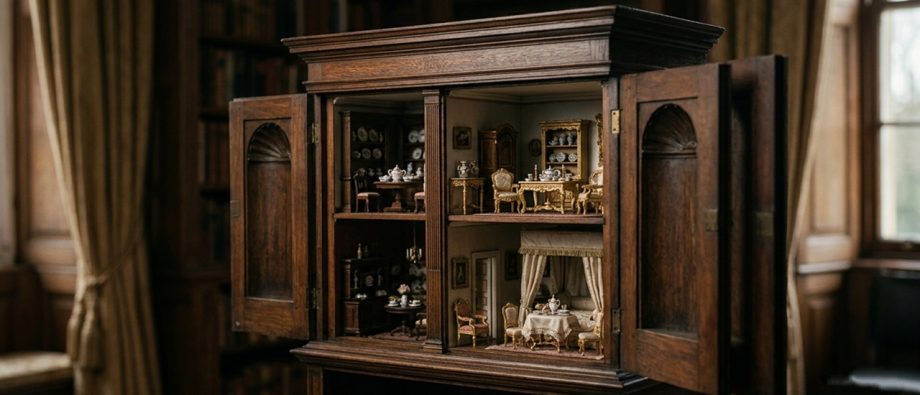
Art & Craft News explores collectible miniatures through a journey into the history of miniature art and the traditions that continue to inspire contemporary makers. What may appear at first to belong to the world of childhood has, for centuries, also attracted adult collectors fascinated by craftsmanship, proportion, materials, and the ability of a small object to preserve the atmosphere of another era. The article approaches historical miniatures not simply as reduced versions of familiar things but as carefully constructed environments in which furniture, textiles, tableware, decoration, and architecture could communicate status, taste, and an idealized vision of everyday life. For the author, discovering such objects became an important source of creative inspiration. Their beauty demonstrated how scale can change the way a viewer pays attention: details that might disappear in a full-sized interior become especially meaningful when recreated by hand in miniature form.
The history of collectible miniatures for adults can be traced in the article to sixteenth-century Europe, when so-called baby houses or cabinet houses began to appear. These were not toys intended for children but elaborate wooden display cabinets containing completely furnished rooms. In Germany and the Netherlands, wealthy aristocrats and prosperous citizens used them as prestigious collectibles and demonstrations of refinement. By the early seventeenth century, miniature houses could function as attractions in their own right. The article mentions the house of Anna Röferlin from 1631, which visitors were reportedly allowed to see for a fee. One of the most striking surviving examples is the cabinet house of Petronella Oortman in Amsterdam, now preserved in the Rijksmuseum. More than two meters high, it contained handcrafted details ranging from silver tableware to tiny paintings. Its value was comparable to that of a real canal house, illustrating the extraordinary resources, skill, and artistic ambition invested in such miniature environments.
These early cabinet houses changed the cultural meaning of miniature objects. Because they were kept locked and opened for guests on special occasions, their purpose was admiration rather than play. The article presents this tradition as an important stage in the development of miniature collecting as an adult artistic interest. Scale became a way of concentrating an entire world into a limited space, while skilled craftsmanship transformed everyday domestic objects into collectible works. The tradition also helps explain why historical miniatures remain powerful sources of inspiration for artists today. They preserve not only physical forms but also traces of social life, aesthetics, materials, and the values of their period. Read the complete story in Art & Craft News to explore this journey through the centuries and discover how encounters with historical miniature collections can influence contemporary creative practice. For makers working today, these examples demonstrate how research, observation, and historical references can become the starting point for a personal artistic language rather than simple reproduction of the past.
Crealandia brings together independent artists and makers working with miniatures, dollhouses, dolls, collectibles, handmade art, craft supplies, patterns, tutorials, and other creative fields. The long history of collectible miniatures shows that small scale does not limit artistic ambition: a miniature room or object can combine woodworking, textiles, painting, decorative arts, architecture, storytelling, and precise craftsmanship within a single composition. Contemporary miniature artists can draw inspiration from historical cabinet houses while developing their own interpretations, materials, periods, and visual worlds. For collectors, the field offers everything from individual furnishings and accessories to complete interiors and carefully constructed scenes. For makers, presenting miniature work together with information about scale, materials, inspiration, and process can help communicate the depth of craftsmanship behind objects that may occupy only a few centimeters of physical space. Crealandia provides a marketplace where such specialized creative work can exist alongside other forms of independent art and handmade design. Visit Crealandia to explore miniature artists, collectible objects, and handmade creative work.